Interactive PDF Lesson Study Kit
Welcome to your generated study kit! This page is the central hub for all the content created from your document. Use the links below to navigate to the different sections.
Core Content
Deeper Dive
Study Tools
Quizzes
Home > Formal Lesson Plan
Formal Lesson Plan
Formal Lesson Plan
Stage 1: Desired Results
- Established Goals:
- Content Standards (Common Core State Standards for Mathematics - N-RN): Use properties of rational and irrational numbers.
- Mathematical Practice Standards (Common Core State Standards for Mathematics - emphasis on 3, 6, 8):
- Make sense of problems and persevere in solving them.
- Reason abstractly and quantitatively.
- Construct viable arguments and critique the reasoning of others.
- Use appropriate tools strategically.
- Attend to precision.
- Look for and make use of structure.
- Look for and express regularity in repeated reasoning.
- Course/Program Objectives: Students will develop a deeper conceptual understanding of number systems, enhance their critical thinking and problem-solving skills, and improve their ability to communicate mathematical reasoning.
- Understandings: Students will understand that... (Big Ideas)
- Rational and irrational numbers possess distinct characteristics, particularly in their decimal representations and ability to be expressed as a ratio of integers.
- The sum, difference, product, and quotient of rational and irrational numbers behave in predictable ways, but also in surprising ways depending on the combination.
- Mathematical statements often require rigorous proof or counterexamples to determine their truth value, moving beyond mere empirical observation.
- Collaborative reasoning and the critique of others' arguments are essential components of mathematical inquiry and understanding.
- A statement being "sometimes true" implies the existence of at least one example for which it is true and at least one for which it is false.
- A "proof" is required to establish that a statement is "always true" or "never true," not just a few confirming examples.
- Essential Questions:
- How can we definitively distinguish between rational and irrational numbers?
- What happens to the rationality or irrationality of numbers when we perform basic arithmetic operations (addition, subtraction, multiplication, division)?
- How many examples are enough to prove a mathematical statement? When are examples not enough?
- What constitutes a strong mathematical argument or a valid counterexample?
- In what ways can understanding the structure of numbers help us predict outcomes or generalize properties?
- Why is precision in language and calculation crucial when discussing rational and irrational numbers?
- Learning Objectives (Bloom's Taxonomy):
- Remember:
- Students will recall the definitions of rational and irrational numbers.
- Students will identify common examples of rational numbers (e.g., integers, fractions, terminating/repeating decimals) and irrational numbers (e.g., $\pi$, $\sqrt{2}$, non-repeating/non-terminating decimals).
- Understand:
- Students will explain in their own words the defining characteristics of rational and irrational numbers.
- Students will differentiate between rational and irrational numbers when presented with various numerical forms (e.g., fractions, decimals, radicals).
- Students will interpret the meaning of "Always True," "Sometimes True," and "Never True" in a mathematical context.
- Apply:
- Students will calculate the perimeter and area of geometric shapes given rational and irrational side lengths.
- Students will apply the properties of rational and irrational numbers to evaluate arithmetic expressions and determine the rationality of the result.
- Students will construct numerical examples to illustrate the truth or falsity of a mathematical statement about rational and irrational numbers.
- Analyze:
- Students will examine given mathematical statements about rational and irrational numbers to determine their underlying assumptions and conditions.
- Students will break down complex statements into simpler components to facilitate analysis.
- Students will identify the range of numbers (e.g., integers, fractions, positive, negative, radicals) that might serve as effective examples or counterexamples for a given statement.
- Evaluate:
- Students will justify their conjectures about the truth value of statements using logical reasoning and appropriate examples/counterexamples.
- Students will critique the reasoning and examples provided by peers, identifying strengths, weaknesses, and potential flaws.
- Students will assess the sufficiency of examples presented to support or refute a claim.
- Create:
- Students will formulate original examples and counterexamples for statements involving rational and irrational numbers.
- Students will construct a collaborative poster that clearly presents their classification, examples, and reasoning for various statements.
- Students will generate a refined explanation of rational and irrational numbers based on new insights gained from collaborative discussion.
Stage 2: Assessment Evidence
- Performance Tasks:
- Initial Assessment Task: "Rational or Irrational?" (Individual, Before Lesson): Students independently define rational and irrational numbers, provide examples, and determine the rationality of perimeter and area for rectangles with given side lengths (e.g., rational/rational, rational/irrational). This pre-assessment gauges prior knowledge and identifies common misconceptions.
- Collaborative Poster Task: "Always, Sometimes or Never True?" (Small Group, During Lesson): Students work in groups to classify a set of statements about rational and irrational numbers (e.g., "The sum of two irrational numbers is irrational") as always, sometimes, or never true. For each statement, they must provide numerical examples to support their conjecture and write a clear explanation of their reasoning on a large poster. This task demonstrates application, analysis, evaluation, and creation of arguments.
- Revisited Assessment Task: "Rational or Irrational? (Revisited)" (Individual, Follow-up Lesson): Students revisit and improve their initial solutions to the "Rational or Irrational?" task, demonstrating growth in understanding and application of learned concepts and improved reasoning skills. They then complete a second, similar task to assess transfer of learning.
- Other Evidence:
- Mini-Whiteboard Responses (During Introduction): Quick checks of understanding as students provide examples and initial conjectures for a sample statement, allowing for real-time formative feedback.
- Teacher Observations & Dialogue (During Group Work): Monitoring student discussions, the types of examples they explore, their problem-solving strategies, and the clarity of their justifications. Teachers will ask probing questions (as outlined in the "Common Issues" table in the document) to guide student thinking.
- Whole-Class Discussion Participation: Assessing students' ability to explain their group's reasoning, compare different justifications, and critique the arguments of others during the structured class discussion.
- Exit Tickets/Journal Entries (Optional): Short written responses reflecting on key learnings, challenges encountered, or a particular concept from the lesson.
- Homework/Practice Problems: Additional exercises focusing on identifying rational/irrational numbers and basic operations to reinforce conceptual understanding.
Stage 3: Learning Plan
Time Allotment:
- Before the Lesson: 15 minutes (Assessment task: "Rational or Irrational?")
- Lesson Day: 60 minutes (Introduction, Collaborative Group Work, Whole-Class Discussion)
- Follow-up Lesson: 20 minutes (Individual Improvement, "Rational or Irrational? Revisited")
Learning Activities:
Phase 1: Before the Lesson - Individual Assessment and Teacher Feedback (15 min)
- Activity: Distribute the "Rational or Irrational?" task. Students work independently to answer questions about defining rational/irrational numbers and analyzing the perimeter/area of rectangles.
- (Bloom's: Remember, Understand, Apply)
- Teacher Role: Collect and review student work. Identify common misconceptions and difficulties using the "Common issues" table. Prepare targeted questions or prompts to guide individual student improvement during the follow-up lesson. Crucially, do not score the work, but focus on formative feedback.
Phase 2: Introduction - Setting the Stage (15 min)
- Activity 1: Structure of the Lesson (5 min)
- Teacher explains the lesson structure, connecting today's activity to the pre-assessment and the upcoming follow-up. Emphasize that the goal is to improve understanding and reasoning.
- (Bloom's: Understand)
- Activity 2: Mini-Whiteboard Exploration - "The hypotenuse of a right triangle is irrational." (10 min)
- Distribute mini-whiteboards, pens, and erasers.
- Teacher writes the statement: "The hypotenuse of a right triangle is irrational."
- Students work individually or in pairs to find examples of right triangles and calculate the hypotenuse.
- Teacher prompts for variety in examples: "What other side lengths could you try?" "How about working backwards? Choose a rational hypotenuse."
- Whole-class discussion: Ask students if their examples made the statement true or false. Introduce the concepts of "Always," "Sometimes," and "Never True." Discuss what evidence (examples, counterexamples, proofs) is needed to establish each category.
- (Bloom's: Apply, Analyze, Evaluate)
Phase 3: Collaborative Small-Group Work - "Always, Sometimes or Never True?" (25 min)
- Activity: Organize students into groups of two or three.
- Display Slide P-1 (Poster with Headings) and Slide P-2 (Instructions). Explain the task: Groups will classify statements as 'Always True', 'Sometimes True', or 'Never True' on a large poster. For 'Sometimes True', they must provide one example where it's true and one where it's false. For 'Always True' and 'Never True', they must explain why.
- Distribute task sheets ("Always, Sometimes or Never True"), poster headings, large paper, scissors, and glue sticks to each group. Hint sheets and calculators are available.
- Students choose a statement, try out various numerical examples (integers, fractions, decimals, negative numbers, radicals, $\pi$), form a conjecture, and record their examples and reasoning on the poster.
- (Bloom's: Apply, Analyze, Evaluate, Create)
- Teacher Role: Circulate among groups.
- Listen: Pay attention to the range of examples students use, their understanding of irrational numbers beyond $\pi$ and $\sqrt{2}$, and the strength of their justifications.
- Support: Ask guiding questions (from the "Common issues" table) rather than providing answers. Prompt students to extend their range of examples (e.g., "What about negative numbers?", "Could you use a fraction?", "What if one side is irrational and the other is rational?"). Distribute the "Rational and Irrational Numbers" hint sheet if needed.
Phase 4: Whole-Class Discussion - Sharing and Critiquing Reasoning (20 min)
- Activity: Bring the class together.
- Each group selects one or two statements from their poster that they found particularly interesting or challenging.
- Groups share their classification, examples, and reasoning for their chosen statements.
- Facilitate a discussion comparing different groups' justifications.
- Prompt students to critique each other's arguments respectfully: "Do you agree with their classification?" "Can anyone provide a different example?" "What makes their explanation convincing?" "What additional evidence would strengthen their argument for 'always true' or 'never true'?"
- Emphasize the difference between showing a statement is "sometimes true" with just two examples (one true, one false) and the need for proof for "always true" or "never true."
- (Bloom's: Understand, Analyze, Evaluate, Create)
Phase 5: Follow-up Lesson - Individual Improvement and Transfer (20 min)
- Activity 1: Improving Individual Solutions (10 min)
- Return the students' initial "Rational or Irrational?" assessment tasks.
- Students reflect on the formative feedback (teacher questions/prompts) and the learning from the collaborative lesson.
- Students work individually to revise and improve their original solutions, demonstrating enhanced understanding and reasoning.
- (Bloom's: Understand, Apply, Evaluate)
- Activity 2: Transfer of Learning - "Rational or Irrational? (revisited)" (10 min)
- Distribute a second, similar task ("Rational or Irrational? (revisited)").
- Students work independently to apply their improved understanding to a new, but related, set of problems.
- (Bloom's: Apply, Analyze, Create)
- Teacher Role: Circulate to provide support as needed. Collect the revised and revisited tasks for final assessment of learning growth.
Home > Summary & Key Points
Summary & Key Points
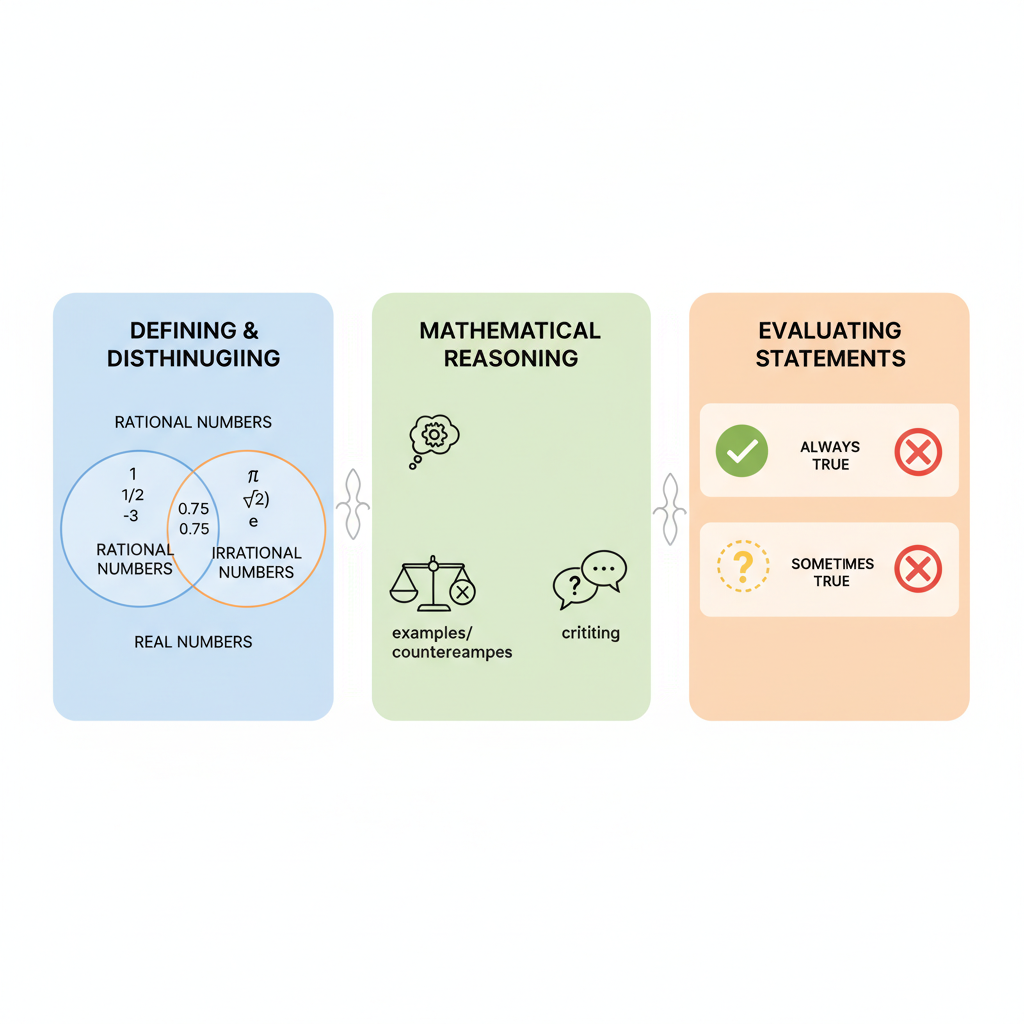
Summary of Main Topics
The provided document outlines a comprehensive formative assessment lesson unit titled "Evaluating Statements about Rational and Irrational Numbers." Its core purpose is to assess and enhance students' abilities to reason about the properties of rational and irrational numbers.
The lesson design emphasizes:
- Defining and Distinguishing: Helping students accurately define and differentiate between rational and irrational numbers.
- Mathematical Reasoning: Developing students' skills in constructing viable arguments, identifying appropriate examples/counterexamples, and critiquing the reasoning of others.
- Evaluating Statements: Classifying mathematical statements concerning rational and irrational numbers as "Always True," "Sometimes True," or "Never True."
- Collaborative Learning: Utilizing small-group work and whole-class discussion to foster deeper understanding and allow students to articulate and justify their mathematical thinking.
- Formative Feedback: Guiding teachers to assess student work for common misconceptions and provide targeted, non-scoring feedback to help students improve their solutions.
- Application: Applying the properties of these number types to solve problems, such as determining the rationality of perimeter and area for geometric figures.
Top 5 Key Takeaways
- Precision in Defining Number Types: A clear and precise understanding of rational numbers (expressible as a fraction of integers, terminating or repeating decimals) and irrational numbers (non-terminating, non-repeating decimals) is foundational for all subsequent reasoning.
- Evidence Beyond Examples: While examples are crucial for exploring mathematical statements, a few confirming examples do not prove a statement is "always true" or "never true"; rigorous proof is required for these categories, whereas "sometimes true" is established by finding one true and one false instance.
- Diverse Numerical Exploration is Key: Effective evaluation of statements about rational and irrational numbers necessitates testing a wide variety of numerical examples, including positive/negative integers, fractions, square roots, and transcendental numbers like $\pi$, to uncover the full scope of possibilities and potential counterexamples.
- Impact of Operations Varies: The sum, difference, product, or quotient of rational and irrational numbers does not always result in a predictable type (e.g., the sum of two irrational numbers can be rational or irrational), requiring careful case-by-case analysis.
- Formative Assessment as a Learning Tool: The lesson structure highlights that identifying student difficulties and providing targeted feedback before formal grading, combined with collaborative problem-solving, is a powerful strategy for improving students' conceptual understanding and mathematical reasoning skills.
See also: 02_Outline, 04_Glossary
Home > Document Outline
Document Outline
Hierarchical Outline for a Mind Map: Evaluating Statements about Rational and Irrational Numbers
- Lesson Unit: Evaluating Statements about Rational and Irrational Numbers
- Overarching Goals
- Assess student reasoning about rational and irrational number properties.
- Identify and assist students with difficulties in:
- Finding examples (rational/irrational) for general statements.
- Reasoning with number properties.
- Common Core State Standards (CCSS)
- Content Standard: N-RN (Use properties of rational and irrational numbers)
- Mathematical Practice Standards (Emphasis on 3, 6, 8):
- 1: Make sense of problems and persevere in solving them.
- 2: Reason abstractly and quantitatively.
- 3: Construct viable arguments and critique the reasoning of others.
- 5: Use appropriate tools strategically.
- 6: Attend to precision.
- 7: Look for and make use of structure.
- 8: Look for and express regularity in repeated reasoning.
- Lesson Structure (Phased Approach)
- Phase 1: Before the Lesson (Individual Assessment)
- Activity: "Rational or Irrational?" Task (15 min)
- Students define rational and irrational numbers in their own words.
- Students provide examples of each.
- Students analyze rectangle perimeter and area based on rational/irrational side lengths (e.g., perimeter rational, area irrational).
- Teacher Role: Formative Assessment
- Review student work to identify difficulties.
- Formulate guiding questions (not scores).
- Identify "Common Issues":
- Poor distinction between number types.
- Failure to attempt problems.
- Lack of supporting examples.
- Limited range of examples (e.g., only $\sqrt{2}$, $\pi$).
- Empirical reasoning (generalizing from insufficient examples).
- Phase 2: During the Lesson (Collaborative Exploration & Discussion)
- Introduction (15 min)
- Explain lesson structure and goals.
- Mini-whiteboard activity: Evaluate "The hypotenuse of a right triangle is irrational."
- Students generate examples/calculations.
- Introduce "Always, Sometimes or Never True" categories.
- Discuss the evidence required for each classification (examples, counterexamples, proof).
- Collaborative Small-Group Work: "Always, Sometimes or Never True?" (25 min)
- Students work in groups (2-3).
- Task: Classify general statements about rational/irrational numbers (e.g., "The sum of two irrational numbers is irrational").
- Process:
- Choose a statement.
- Try out diverse numerical examples (integers, fractions, decimals, negative numbers, radicals, $\pi$).
- Form a conjecture (Always/Sometimes/Never True).
- Record examples and reasoning on a poster.
- Teacher Role: Facilitate and support.
- Listen to student discussions (range of examples, depth of justification).
- Support problem-solving by asking guiding questions and prompting for broader examples.
- Provide hint sheets if needed.
- Whole-Class Discussion
- Groups share and explain their classifications and reasoning.
- Students compare and critique different justifications.
- Reinforce understanding of necessary evidence for each category.
- Phase 3: Follow-up Lesson (Individual Improvement & Transfer)
- Activity 1: Students use teacher feedback to improve their original "Rational or Irrational?" assessment task.
- Activity 2: Students complete a second, similar task: "Rational or Irrational? (revisited)".
- Key Mathematical Concepts Explored
- Definitions:
- Rational numbers (fraction p/q, terminating/repeating decimals).
- Irrational numbers (non-terminating, non-repeating decimals, e.g., $\pi$, $\sqrt{X}$ where X is not a perfect square).
- Properties of Operations:
- Sum, difference, product, and quotient of rational numbers.
- Sum, difference, product, and quotient involving combinations of rational and irrational numbers.
- Geometric Applications:
- Perimeter and area of rectangles.
- Nature of Mathematical Truth:
- Distinction between conjecture and proof.
- The role and sufficiency of examples and counterexamples.
- Materials Required
- Student: Mini-whiteboards, "Rational or Irrational?", "Rational or Irrational? (revisited)".
- Group: "Always, Sometimes or Never True" task sheet, Poster Headings, large sheet of paper, scissors, glue stick.
- Optional/Support: "Rational and Irrational Numbers" hint sheet, Extension Task, Calculators, Projectable resources.
- Time Needed (Approximate)
- 15 minutes (Before Lesson Assessment)
- 60 minutes (Main Lesson)
- 20 minutes (Follow-up Lesson)
For a more detailed explanation, see the 03_Study_Guide.
Home > Detailed Study Guide
Detailed Study Guide
This study guide provides a detailed explanation of the key topics, concepts, and themes presented in the document, "Evaluating Statements about Rational and Irrational Numbers." This lesson unit is designed to enhance students' reasoning abilities concerning these fundamental number types.
Study Guide: Evaluating Statements about Rational and Irrational Numbers
1. Introduction and Core Purpose
This lesson unit is a formative assessment experience aimed at helping students deepen their understanding of rational and irrational numbers and their properties. It's structured to allow teachers to identify common student difficulties, provide targeted support, and foster a collaborative learning environment where students actively construct and critique mathematical arguments. The ultimate goal is to move students beyond rote memorization of definitions to a robust conceptual understanding and the ability to reason with these number types.
2. Fundamental Concepts: Rational and Irrational Numbers
At the heart of this lesson are the definitions and characteristics of rational and irrational numbers.
2.1 Rational Numbers
A rational number is any number that can be expressed as a fraction $\frac{p}{q}$ where $p$ and $q$ are integers, and $q$ is not zero.
- Characteristics:
- Can be written as a fraction.
- In decimal form, they either terminate (e.g., $0.5$, $0.25$) or repeat in a pattern (e.g., $0.333...$, $0.142857142857...$).
- Examples: Integers ($3, -7$), fractions ($\frac{1}{2}, -\frac{3}{4}$), mixed numbers ($1\frac{2}{3}$), terminating decimals ($0.75$), repeating decimals ($0.\overline{6}$).
2.2 Irrational Numbers
An irrational number is a real number that cannot be expressed as a simple fraction $\frac{p}{q}$.
- Characteristics:
- Cannot be written as a fraction of integers.
- In decimal form, they are non-terminating (go on forever) and non-repeating (do not form a repeating pattern).
- Examples:
- Non-perfect square roots: $\sqrt{2}, \sqrt{3}, \sqrt{5}$ (and $\sqrt[n]{x}$ where $x$ is not a perfect $n$-th power).
- Pi ($\pi$): The ratio of a circle's circumference to its diameter, approximately $3.14159...$.
- Euler's number ($e$): The base of the natural logarithm, approximately $2.71828...$.
- Other non-repeating, non-terminating decimals explicitly constructed, like $0.101101110...$.
3. Properties of Operations with Rational and Irrational Numbers
A key theme of the lesson is exploring how different arithmetic operations (addition, subtraction, multiplication, division) affect the rationality of numbers. Students often hold misconceptions about these properties.
- Rational + Rational = Rational: (e.g., $2 + \frac{1}{3} = \frac{7}{3}$)
- Rational - Rational = Rational: (e.g., $2 - \frac{1}{3} = \frac{5}{3}$)
- Rational * Rational = Rational: (e.g., $2 * \frac{1}{3} = \frac{2}{3}$)
- Rational / Rational = Rational: (e.g., $2 / \frac{1}{3} = 6$)
However, when involving irrational numbers, the outcomes can be less straightforward:
- Rational + Irrational = Irrational: (e.g., $2 + \sqrt{3}$)
- Rational - Irrational = Irrational: (e.g., $2 - \sqrt{3}$)
- Rational * Irrational = Irrational (if rational is non-zero): (e.g., $2 * \sqrt{3}$). If the rational number is zero, the product is zero (rational).
- Rational / Irrational = Irrational (if rational is non-zero): (e.g., $2 / \sqrt{3}$). If the rational number is zero, the quotient is zero (rational).
The most interesting cases arise when operating with two irrational numbers:
- Irrational + Irrational: Can be Rational (e.g., $\sqrt{2} + (-\sqrt{2}) = 0$) or Irrational (e.g., $\sqrt{2} + \sqrt{3}$).
- Irrational - Irrational: Can be Rational (e.g., $\sqrt{2} - \sqrt{2} = 0$) or Irrational (e.g., $\sqrt{3} - \sqrt{2}$).
- Irrational * Irrational: Can be Rational (e.g., $\sqrt{2} * \sqrt{2} = 2$) or Irrational (e.g., $\sqrt{2} * \sqrt{3} = \sqrt{6}$).
- Irrational / Irrational: Can be Rational (e.g., $\sqrt{2} / \sqrt{2} = 1$) or Irrational (e.g., $\sqrt{6} / \sqrt{2} = \sqrt{3}$).
Understanding these possibilities is crucial for accurately evaluating statements.
4. Mathematical Reasoning and Proof
A central theme of this lesson is the development of robust mathematical reasoning skills, moving beyond simple calculation.
4.1 "Always, Sometimes, or Never True" Framework
Students are challenged to classify statements as:
- Always True: The statement holds for all possible instances. To prove this definitively requires a general mathematical proof.
- Sometimes True: The statement holds for at least one instance, but not for all. To prove this, one must provide one example where it's true AND one example where it's false.
- Never True: The statement does not hold for any possible instance. To prove this definitively requires a general mathematical proof that no such instance exists.
4.2 The Role of Examples and Counterexamples
- Examples: Used to illustrate when a statement might be true or to support a conjecture.
- Counterexamples: A specific instance that proves a general statement is false. Finding a single counterexample is sufficient to show a statement is NOT "Always True" and often helps establish "Sometimes True" or "Never True."
- Importance of Diversity: Students are encouraged to test a wide range of numbers (positive, negative, fractions, decimals, radicals, $\pi$) to ensure their conjectures are well-founded and to avoid prematurely concluding "Always True" or "Never True" based on limited observations.
4.3 Conjecture vs. Proof
The lesson differentiates between forming a conjecture (an educated guess based on observations/examples) and providing a proof (a rigorous argument that definitively establishes the truth or falsity of a statement). While proofs for some statements may be beyond the scope of a high school lesson, students learn the need for proof to establish "Always True" or "Never True."
5. Lesson Structure and Pedagogical Approach
The lesson utilizes a formative assessment cycle to support student learning.
5.1 Before the Lesson: Individual Assessment ("Rational or Irrational?")
- Students complete an individual task covering definitions, examples, and application of rational/irrational properties in a geometric context (e.g., perimeter and area of rectangles).
- Purpose: To gauge prior knowledge, identify existing misconceptions, and allow the teacher to prepare targeted support.
5.2 Teacher Feedback: Non-Scoring and Diagnostic
- Teachers review student work without assigning scores.
- Instead, they provide diagnostic feedback in the form of guiding questions and prompts. This encourages students to reflect on their own thinking and make improvements, rather than focusing on a grade.
- Common Issues Addressed:
- Incorrect definitions or lack of examples.
- Failure to apply formulas (e.g., area/perimeter).
- Limited range of examples leading to incorrect generalizations.
- Reliance on empirical reasoning without seeking general explanations or proofs.
5.3 During the Lesson: Collaborative Exploration
- Introduction: A mini-whiteboard activity introduces the "Always, Sometimes, Never True" concept with a simple statement (e.g., about hypotenuses), establishing the need for examples and reasoning.
- Group Work ("Always, Sometimes or Never True?"): Students work in small groups to classify a series of statements about rational and irrational numbers. They must provide examples and justifications for their classifications on a poster. This fosters discussion, problem-solving, and the construction of arguments.
- Teacher Role: Facilitate by listening to group discussions, prompting deeper thinking with questions, and ensuring a wide range of examples are considered.
5.4 Whole-Class Discussion: Sharing and Critiquing
- Groups share their findings and reasoning for selected statements.
- Students compare different justifications, articulate their own arguments, and critique the reasoning of their peers. This refines understanding and reinforces the importance of clear, precise communication in mathematics.
5.5 Follow-up Lesson: Individual Improvement and Transfer
- Students revisit their initial assessment tasks, applying insights gained from the collaborative lesson and teacher feedback to improve their solutions.
- They then complete a similar, new task ("Rational or Irrational? Revisited") to demonstrate transfer of learning and increased confidence in reasoning about these number types.
6. Connection to Common Core State Standards for Mathematical Practice
This lesson unit is strongly aligned with several CCSS Mathematical Practice standards, particularly:
- MP3: Construct viable arguments and critique the reasoning of others. Students actively create and defend their classifications and evaluate the logic of their peers.
- MP6: Attend to precision. Students must use precise mathematical language in their definitions, examples, and justifications.
- MP8: Look for and express regularity in repeated reasoning. Students observe patterns when testing different numerical examples, leading them to form conjectures about general properties of rational and irrational numbers under various operations.
By engaging in these activities, students not only solidify their understanding of rational and irrational numbers but also develop critical mathematical thinking skills essential for higher-level mathematics.
For a guided walk-through of the core topics, see the 09_Study_Path_Index.
See also: 05_Timeline, 06_Applications, 07_Hierarchical_Terms
Home > Glossary of Key Terms
Glossary of Key Terms
Rational Number
A number that can always be written as a fraction of two integers (p/q, where q is not zero). Its decimal representation is either terminating or repeating.
Irrational Number
A number that cannot be written as a fraction of two integers. Its decimal representation is non-terminating and non-repeating.
Formative Assessment Lesson
A lesson unit designed to help teachers assess student understanding and reasoning, identify common difficulties, and provide targeted assistance to improve learning, rather than assigning a summative score.
Properties of Rational and Irrational Numbers
The rules governing how rational and irrational numbers behave under arithmetic operations (addition, subtraction, multiplication, division), determining whether the result of such operations is rational or irrational.
Always True
A classification for a mathematical statement that holds true for all possible cases and requires a general proof to be definitively established.
Sometimes True
A classification for a mathematical statement that holds true for at least one case but is false for at least one other case. This is established by providing one true example and one false example.
Never True
A classification for a mathematical statement that does not hold true for any possible case and requires a general proof to be definitively established.
Conjecture
An educated guess or statement formed based on observations and examples, but not yet rigorously proven.
Proof
A rigorous, logical argument that demonstrates the truth or falsity of a mathematical statement for all possible cases.
Example
A specific instance or set of values used to illustrate or support a mathematical statement or conjecture.
Counterexample
A specific instance that disproves a general mathematical statement; finding a single counterexample is sufficient to show a statement is not 'Always True'.
Common Core State Standards (CCSS) N-RN
A specific content standard in the Common Core State Standards for Mathematics that focuses on students' ability to use the properties of rational and irrational numbers.
Mathematical Practice Standards
A set of eight standards within the Common Core State Standards that describe varieties of expertise that mathematics educators should seek to develop in their students, including reasoning, precision, and argument construction.
Empirical Reasoning
A type of reasoning that relies on observations and specific examples to form conclusions, which can lead to false generalizations if not rigorously supported by proof.
Mini-whiteboards
A teaching tool used for quick, informal student responses and immediate feedback during a lesson.
Rational or Irrational? Task
An individual assessment task given before the lesson to evaluate students' initial understanding of rational and irrational numbers, including definitions and application to geometric properties.
Always, Sometimes or Never True Task
A collaborative group activity where students classify mathematical statements about rational and irrational numbers into categories based on whether they are always, sometimes, or never true, providing examples and justifications.
See also: 01_Summary
Home > Timeline of Discoveries
Timeline of Discoveries
Around 3000 BCE: Early practical use of rational numbers (fractions) for trade and measurements by ancient civilizations.
- By: Ancient Babylonians and Egyptians
- Source
5th Century BCE: Discovery of irrational numbers, specifically the incommensurability of the diagonal of a square (e.g., square root of 2).
- By: Hippasus of Metapontum
- Source
Around 300 BCE: Formalization of the study of ratios and proportions by ancient Greek mathematicians, distinguishing rational from irrational numbers.
1872: Introduction of Dedekind cuts, providing a rigorous construction and definition of real numbers from rational numbers, formally distinguishing rational and irrational numbers.
2010: Release of the Common Core State Standards in Mathematics and English Language Arts to standardize K-12 educational expectations across U.S. states.
- By: National Governors Association (NGA) and Council of Chief State School Officers (CCSSO)
- Source
See also: 03_Study_Guide
Home > Real-World Applications
Real-World Applications
Engineering & Architecture
Irrational numbers like the square root of 2 and the golden ratio (φ) are fundamental in engineering and architectural design. For instance, the diagonal of a square with unit side length is √2, an irrational number, which is significant in structural layouts and material cutting. The golden ratio, an irrational number approximately 1.618, is often applied to achieve aesthetically pleasing proportions in buildings, bridges, and artistic compositions.
Physics & Scientific Research
Many fundamental physical constants are irrational, making them essential in scientific calculations. Pi (π), an irrational number, is indispensable for calculations involving circles, spheres, waves, and oscillations, such as determining the volume of celestial bodies or the frequency of light. Euler's number (e), also irrational, describes continuous growth and decay processes, fundamental in fields like thermodynamics, radioactivity, and population dynamics.
Computer Science & Digital Media
In computer graphics, simulations, and digital signal processing, computers approximate irrational numbers using floating-point arithmetic. This is critical for rendering realistic 3D models, where curves, circles, and complex shapes involve π and other irrational values. Accurate approximations are also vital for scientific simulations modeling physical systems and for processing audio and image data, which often utilize Fourier transforms involving π.
Finance & Economics
Euler's number (e) plays a critical role in financial modeling, particularly in continuous compound interest calculations, which provide a more accurate representation of interest accrual over time compared to discrete compounding. It is also used in advanced economic models to describe exponential growth or decay of various financial and economic indicators, such as asset valuation, inflation rates, or population growth models.
Navigation & Global Positioning Systems (GPS)
Precise navigation systems, including GPS, rely on complex geometric calculations involving distances, angles, and coordinates on the Earth's surface. While many measurements are rational, the underlying trigonometric functions used to determine positions and bearings often yield irrational values (e.g., sine or cosine of many angles). These irrational values are approximated with high precision to ensure accurate and reliable location services.
See also: 03_Study_Guide
Home > Key Terms & Concepts
Key Terms & Concepts
- Lesson Unit
- Evaluating Statements about Rational and Irrational Numbers
- Formative Assessment Lesson
- Mathematical Goals
- Assess student reasoning
- Identify student difficulties
- Assist students in reasoning
- Finding examples (rational and irrational)
- Reasoning with properties of numbers
- Common Core State Standards
- Standards for Mathematical Content
- N-RN: Use properties of rational and irrational numbers
- Standards for Mathematical Practice
- 1. Make sense of problems and persevere
- 2. Reason abstractly and quantitatively
- 3. Construct viable arguments and critique reasoning
- 5. Use appropriate tools strategically
- 6. Attend to precision
- 7. Look for and make use of structure
- 8. Look for and express regularity in repeated reasoning
- Lesson Structure
- Before the lesson (Individual Assessment)
- Assessment task: Rational or Irrational?
- Reviewing student work (Teacher)
- Formulate questions for improvement (Teacher)
- During the lesson (Collaborative Work & Discussion)
- Collaborative small-group work: Always, Sometimes or Never True?
- Whole-class discussion
- Follow-up lesson (Individual Improvement)
- Improve individual solutions to initial task
- Second, similar task
- Key Concepts and Tasks
- Rational Numbers
- Definition
- Examples
- Decimal representations (terminating/repeating)
- Fraction of integers
- Irrational Numbers
- Definition
- Examples
- Decimal representations (non-repeating non-terminating)
- Cannot be written as fraction of integers
- Evaluating Statements
- Always True
- Sometimes True
- Never True
- Reasoning and Justification
- Finding examples
- Constructing arguments
- Critiquing reasoning
- Conjectures
- Proof (concept of)
- Range of examples (integers, fractions, decimals, negative, radicals, pi)
- Common Issues for Students
- Distinguishing rational/irrational
- Not attempting questions
- Not providing examples
- Limited range of examples
- Empirical reasoning (false generalizations)
- Application Contexts
- Rectangle perimeter and area
- Hypotenuse of a right triangle
- Materials Required
- Mini-whiteboard, pen, eraser
- Rational or Irrational? task sheet
- Rational or Irrational? (revisited) task sheet
- Always, Sometimes or Never True task sheet
- Poster Headings
- Large sheet of paper
- Scissors
- Glue stick
- Rational and Irrational Numbers hint sheet
- Extension Task
- Calculators
- Projectable resource
- Time Needed
- 15 minutes (Before Lesson)
- 60 minutes (Main Lesson)
- 20 minutes (Follow-up Lesson)
See also: 03_Study_Guide
Home > In-depth Study Path
In-depth Study Path
This is a guided path through the core concepts of the document. Start with the first topic and follow the links at the bottom of each page to proceed.
See also: 03_Study_Guide
Home > Multiple Choice Quiz
Multiple Choice Quiz
Home > Image & Asset Gallery
Image & Asset Gallery
This page contains a collection of all images found in the uploaded document as well as those generated by the AI.
Generated Illustrations
Summary Illustration
Summary Illustration
Mind Map Visualization
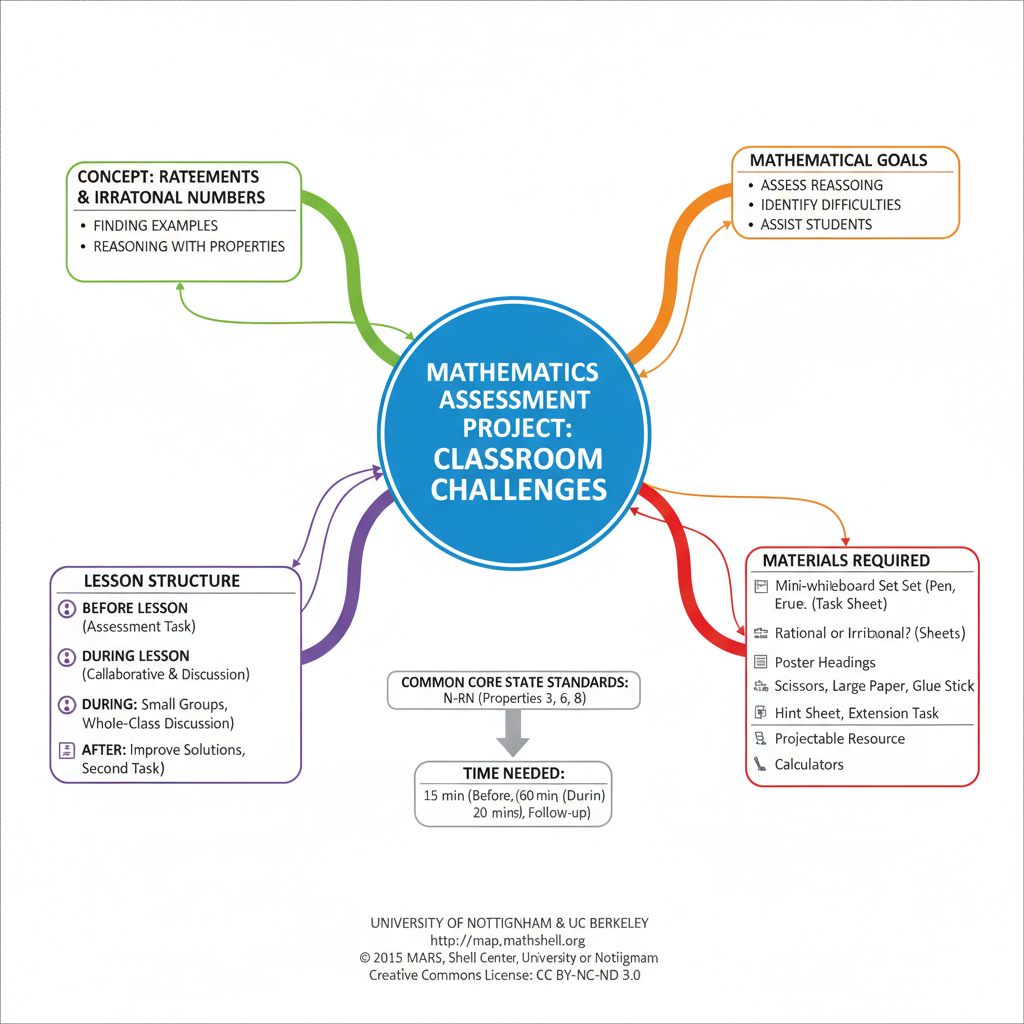
Mind Map Visualization
Illustration for Segment 1
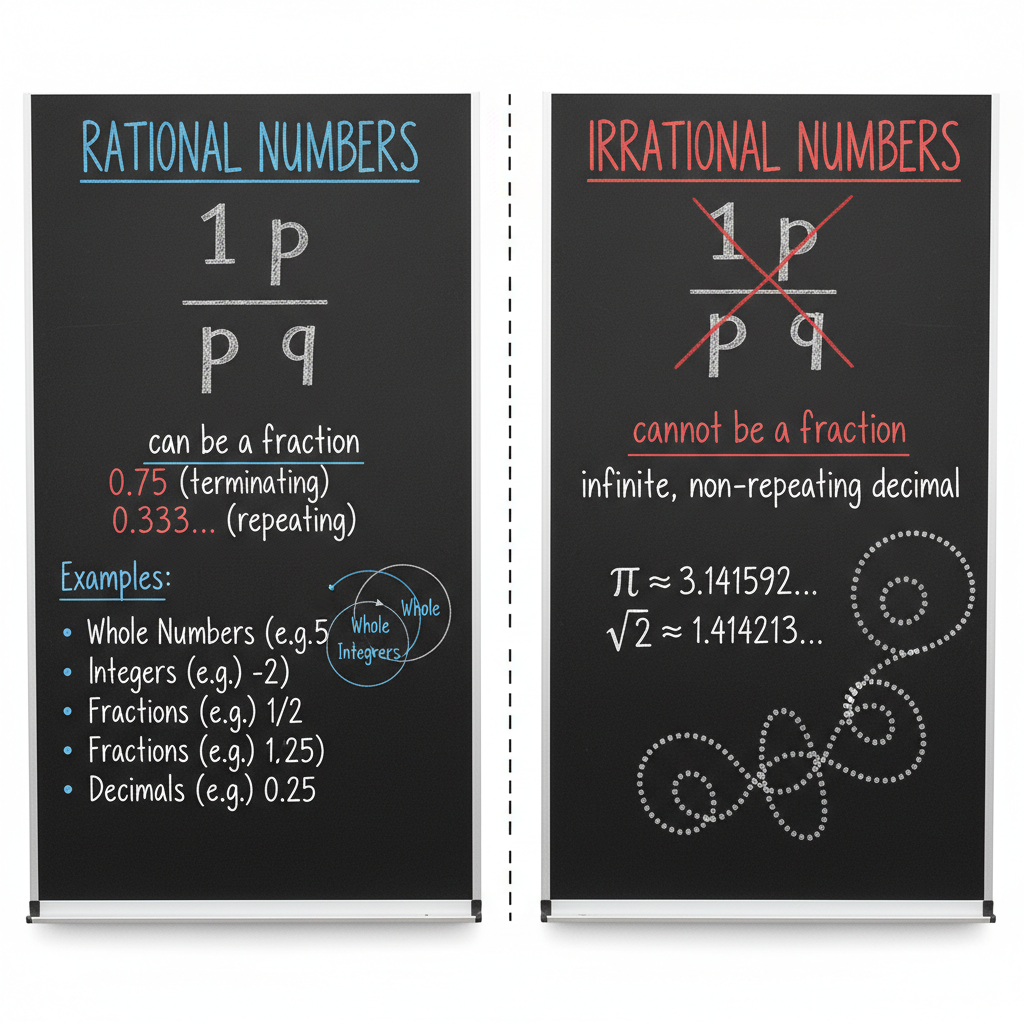
Illustration for Segment 1: Defining and Distinguishing Rational & Irrational Numbers
Illustration for Segment 2
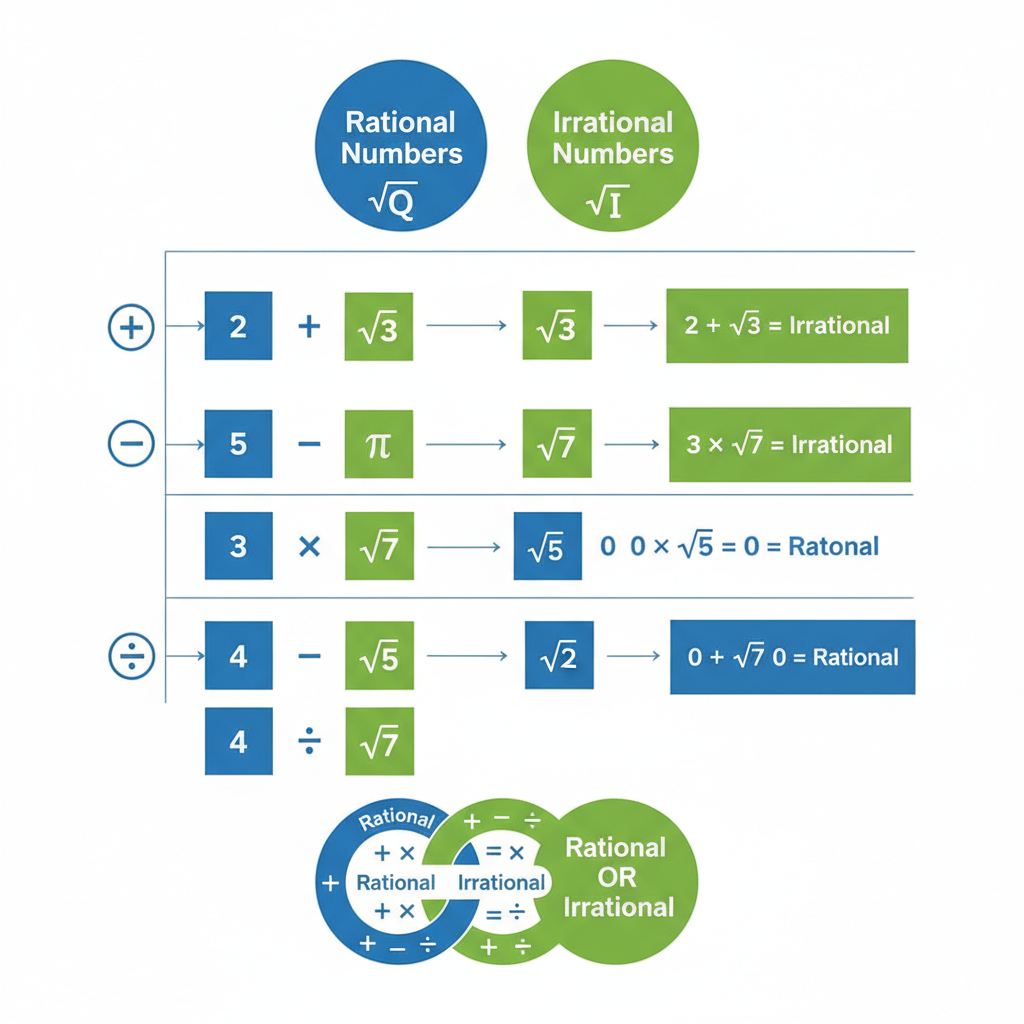
Illustration for Segment 2: Properties of Operations with Rational and Irrational Numbers
Illustration for Segment 3
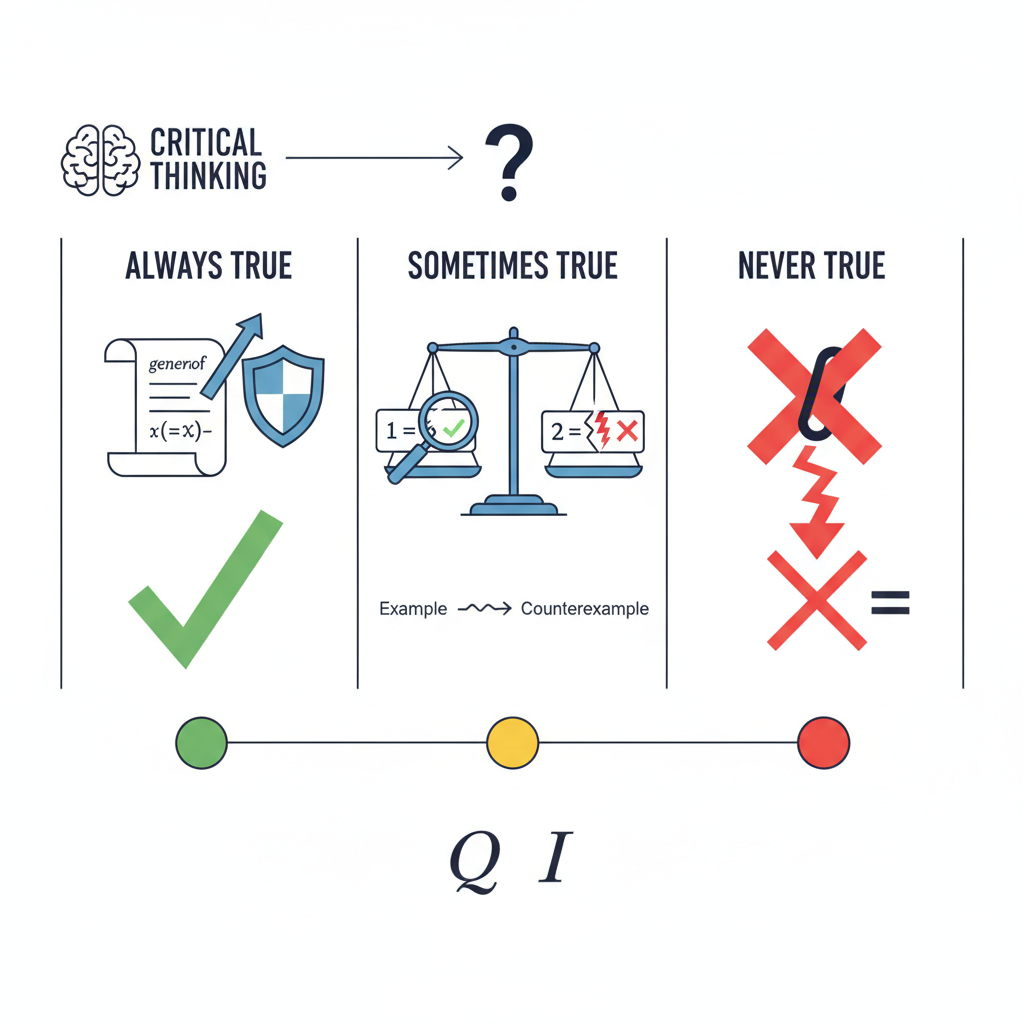
Illustration for Segment 3: Evaluating Mathematical Statements: Always, Sometimes, or Never True
Illustration for Segment 4

Illustration for Segment 4: The Formative Assessment Cycle and Pedagogical Strategies
See also: Home
Home > In-depth Study Path > Segment 1: Defining and Distinguishing Rational & Irrational Numbers
Segment 1: Defining and Distinguishing Rational & Irrational Numbers
This foundational segment focuses on establishing a clear understanding of rational and irrational numbers. A rational number is defined as any number that can be expressed as a fraction $\frac{p}{q}$, where $p$ and $q$ are integers and $q \neq 0$. In decimal form, rational numbers either terminate (e.g., $0.75$) or repeat in a predictable pattern (e.g., $0.\overline{3}$). Examples include whole numbers, integers, fractions, and terminating/repeating decimals.
Conversely, an irrational number cannot be expressed as a simple fraction. Their decimal representations are infinite, non-repeating, and non-terminating (e.g., $\pi$, $\sqrt{2}$). Understanding the distinction, particularly through examining their decimal forms and ability to be written as a ratio, is crucial. Students are often asked to provide examples and explanations in their own words, highlighting their grasp of these core definitions. Common difficulties in this area include providing incomplete definitions or confusing characteristics of the two number types.
➡️ Next: Segment 2: Properties of Operations with Rational and Irrational Numbers
Home > In-depth Study Path > Segment 2: Properties of Operations with Rational and Irrational Numbers
Segment 2: Properties of Operations with Rational and Irrational Numbers
Building upon the definitions, this segment explores how rational and irrational numbers behave under basic arithmetic operations: addition, subtraction, multiplication, and division. While operations involving only rational numbers always result in a rational number, combinations with irrational numbers can yield varied outcomes.
- Rational + Irrational = Irrational: (e.g., $2 + \sqrt{3}$)
- Rational - Irrational = Irrational: (e.g., $5 - \pi$)
- Rational * Irrational = Irrational (unless the rational number is zero, e.g., $3 \times \sqrt{7}$; $0 \times \sqrt{5} = 0$, which is rational).
- Rational / Irrational = Irrational (unless the rational number is zero, e.g., $4 \div \sqrt{2}$; $0 \div \sqrt{7} = 0$, which is rational).
The most complex interactions occur when two irrational numbers are operated upon, as the result can be either rational or irrational.
- Irrational + Irrational: Can be rational (e.g., $\sqrt{2} + (-\sqrt{2}) = 0$) or irrational (e.g., $\sqrt{2} + \sqrt{3}$).
- Irrational * Irrational: Can be rational (e.g., $\sqrt{2} \times \sqrt{2} = 2$) or irrational (e.g., $\sqrt{2} \times \sqrt{5} = \sqrt{10}$).
Students must move beyond simple assumptions and test various examples to fully grasp these properties, recognizing that some operations with irrationals are not closed.
⬅️ Previous: Segment 1: Defining and Distinguishing Rational & Irrational Numbers | ➡️ Next: Segment 3: Evaluating Mathematical Statements: Always, Sometimes, or Never True
Home > In-depth Study Path > Segment 3: Evaluating Mathematical Statements: Always, Sometimes, or Never True
Segment 3: Evaluating Mathematical Statements: Always, Sometimes, or Never True
This segment introduces a critical thinking framework for evaluating mathematical statements. Students classify statements about rational and irrational numbers into one of three categories:
- Always True: The statement holds for every conceivable instance. To prove a statement is 'Always True' requires a general mathematical proof, not just numerous examples.
- Sometimes True: The statement holds for at least one specific instance, but it also fails for at least one other instance. To establish 'Sometimes True,' students must provide both a true example and a counterexample (an example where the statement is false).
- Never True: The statement does not hold for any possible instance. Like 'Always True,' proving a statement is 'Never True' requires a general mathematical proof.
Students are encouraged to form conjectures (educated guesses) based on exploring a wide range of diverse numerical examples, including integers, fractions, negative numbers, various radicals, and $\pi$. A key learning objective is distinguishing between merely finding supporting examples and constructing a rigorous argument or proof, recognizing that limited empirical evidence is insufficient for 'Always' or 'Never True' classifications.
⬅️ Previous: Segment 2: Properties of Operations with Rational and Irrational Numbers | ➡️ Next: Segment 4: The Formative Assessment Cycle and Pedagogical Strategies
Home > In-depth Study Path > Segment 4: The Formative Assessment Cycle and Pedagogical Strategies
Segment 4: The Formative Assessment Cycle and Pedagogical Strategies
The lesson unit employs a structured formative assessment cycle to facilitate deep learning. It begins with a pre-assessment task ('Rational or Irrational?') where students work individually to demonstrate their initial understanding. The teacher then provides non-scoring, diagnostic feedback, typically in the form of guiding questions, to prompt student reflection and improvement rather than simply assigning a grade. This proactive approach aims to address 'common issues' such as students providing insufficient examples, exhibiting empirical reasoning (drawing broad conclusions from too few examples), or struggling to distinguish between number types.
The core of the lesson involves collaborative small-group work ('Always, Sometimes or Never True?'), where students actively experiment with numbers, formulate conjectures, and justify their reasoning on shared posters. This is followed by a whole-class discussion, allowing groups to explain their classifications and critique the arguments of others, thereby solidifying their understanding of mathematical argumentation (aligned with CCSS Mathematical Practice Standards, particularly MP3 and MP6). Finally, students revisit and improve their initial solutions and complete a similar task to demonstrate growth and transfer of learning, reinforcing the cycle of assessment, feedback, and refinement.
⬅️ Previous: Segment 3: Evaluating Mathematical Statements: Always, Sometimes, or Never True